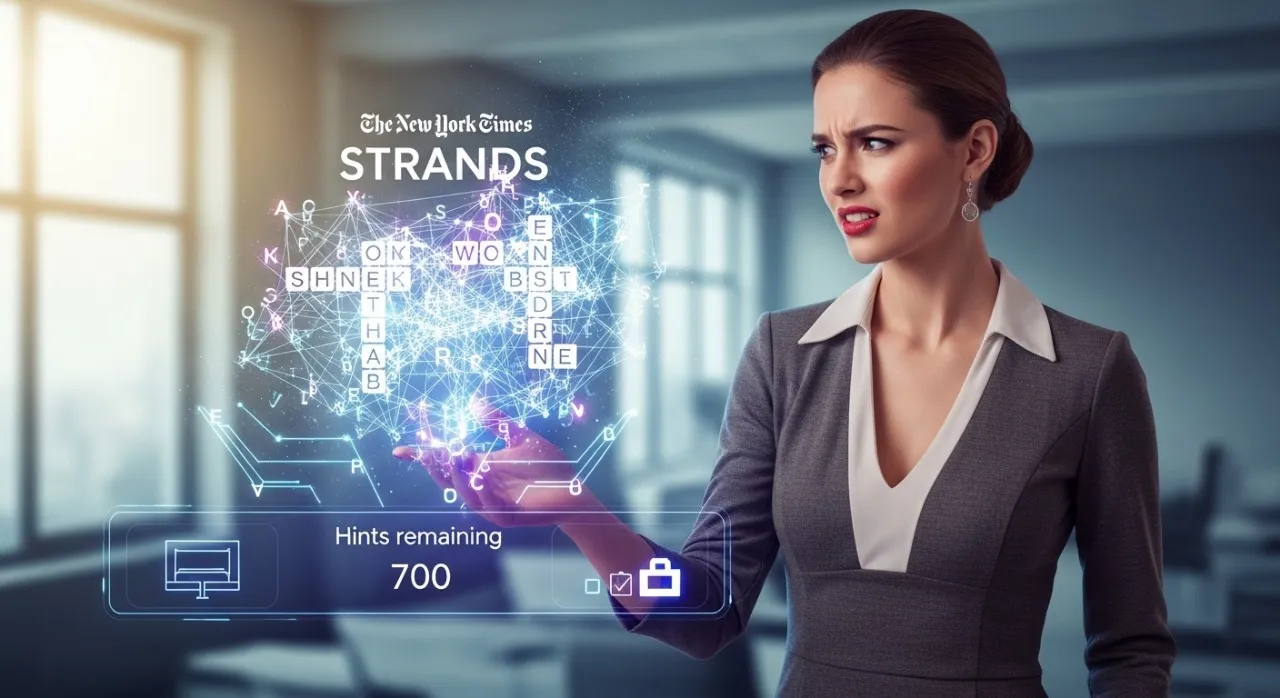
Just when we thought we were safe. Just when we had mastered Wordle and finally figured out the logic of Connections, the New York Times dropped a new nightmare into the Games app.
It’s called Strands. And it is absolutely maddening.
If you haven’t played it yet, imagine if a Word Search had a baby with a game of Snake, and that baby was raised by a cryptic riddler. You stare at a 6×8 grid of letters. There is a vague clue like “Heavy Metal.” And you have to find words that snake, twist, and turn through the grid. They don’t just go straight; they go L-shaped, U-shaped, and Z-shaped.
It is visual chaos. For the first few minutes, you just stare at the board seeing nothing but XQZJK. But unlike Wordle, you can’t just guess. You have to find it.
If you are tired of staring at the board until your headache starts, or if you rely on the “Hint” button way too much, here is how to train your eyes to see the snakes in the grass.
1. The “Junk Word” Strategy (The Hint Farmer)
This is the most important mechanic in the game, and new players ignore it. In Strands, finding “wrong” words is actually good.
If you see the word CAT, but “CAT” isn’t part of the theme… trace it anyway. Why? Because Strands has a “Hint Meter.” If you find 3 non-theme words, you earn a Hint. The game will highlight a specific area and say “Look here.”
The Strategy: When you first open the board, don’t try to solve the puzzle. Just go into “Boggle Mode.” Find ANY word. DOG. HAT. TEN. PEN. Spam the board with short, 3-letter words. You are “farming” hints. Once you have unlocked a Hint, don’t use it yet. Just knowing you have it reduces the panic. Often, while looking for junk words, you will accidentally stumble upon a Theme Word (which turns blue). It’s a win-win.
2. Hunt the “Spangram” First (The Yellow Brick Road)
Every puzzle has one “God Word.” It is called the Spangram.
It describes the entire puzzle.
It touches two opposite sides of the board (Left-to-Right or Top-to-Bottom).
It turns Yellow when found.
This is your anchor. If the clue is “Yummy!”, the Spangram might be DELICIOUS. If you can find the Spangram, it splits the board in half. It isolates the remaining letters into smaller pockets.
How to spot it: Look for “clusters” of related letters that form a line across the center. If you see an S on the far left and a M on the far right, try to connect them. The Spangram is usually a compound word (like BOOKSHELF) or two words (like CARDGAMES).
3. The “Corner Trap” Technique
Strands is a game of space efficiency. Every single letter on the board is used. There are no leftovers. This means the corners are vulnerable.
Look at the Top-Left corner letter. Let’s say it’s a Q. That Q must be used. It only has 2 or 3 neighbors. It has to connect to one of them. Trace the path out of the corner. Q… U… I… E… T. Boom. You found a word.
If you are stuck, stop looking at the messy center. Look at the isolated corners. They have fewer options, which makes the words easier to see.
4. Don’t Think in Straight Lines
This is the hardest habit to break. We are trained by traditional Word Searches to look Horizontal, Vertical, or Diagonal. Strands laughs at straight lines. Strands wants you to make a U-turn.
A word might start at the top, go down, and then curve back up.
A word might spiral into itself.
The Visualization Trick: Stop looking for words. Start looking for Chunks. If the category is “Pizza Toppings,” don’t look for the word PEPPERONI. Look for the chunk PEP. Look for the chunk RONI. Then try to bridge them. Your brain is better at spotting small clusters than long twisting snakes.
5. The “Theme” Lie (The Cryptic Clue)
The clue at the top is often a lie. Or at least, a riddle.
Clue: “Wrap it up.”
You think: Sandwiches? Burritos?
The Answer: MUMMY, BANDAGE, CAST, GIFT.
Clue: “Play time.”
You think: Toys? Games?
The Answer: THEATER, ACTOR, SCRIPT, STAGE.
If you can’t find anything, your definition of the clue is wrong. Pivot. Think laterally. If the clue is “Rock and Roll,” it might not be music. It might be GEOLOGY (Stones, Boulders) or BAKING (Bread, Rolls). Don’t get tunnel vision on your first interpretation.
6. The “Double Letter” Anchor
Strands loves double letters. EE, OO, TT, SS. These stand out visually in the grid. If you see two Ls next to each other, stare at them. Is it BALL? BELL? HELLO? Double letters are often the hinge where a word turns a corner. Use them as your starting point.
7. The Regional Struggle (For the Non-Americans)
I have to apologize to my friends in London, Sydney, and Toronto. Like Wordle, Strands is very American.
We had a puzzle recently where the answers were types of US Dollar Bills (Washington, Lincoln, Hamilton). If you live in Europe, you were probably staring at the board screaming “Who is Hamilton??”
If the category feels totally impossible, assume it is:
US Sports Teams (Knicks, Mets).
US Candy Brands (Snickers, Twix).
US Currency/Presidents.
If you see a word that looks like a proper noun you don’t recognize, just trace it. It’s probably an American thing.
Strands is harder than Wordle because it requires visual agility. You have to untangle the knot with your eyes.
But the dopamine hit when you find the Spangram? Unmatched. Just remember:
Fill the Hint Meter with junk words first.
Check the corners.
And if the clue makes no sense, think about what a New Yorker would say.
Now go find that yellow snake.