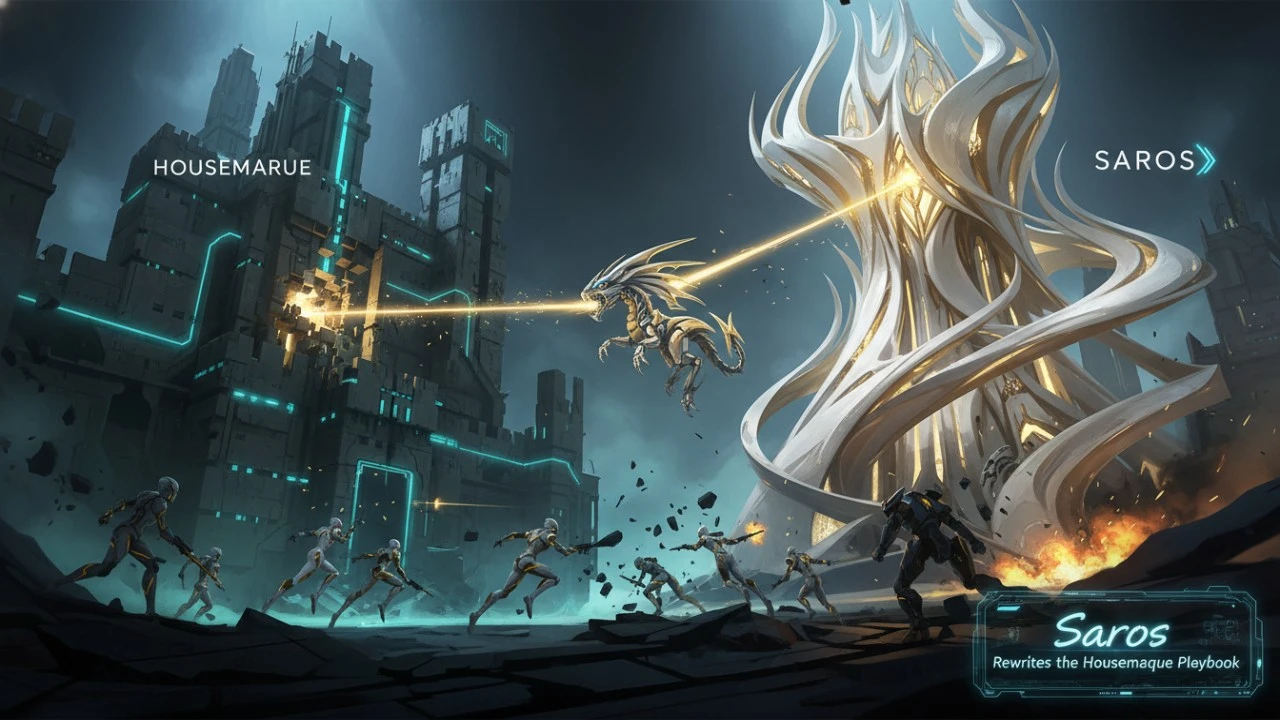
You boot up the first trailer, and the immediate visceral reaction is a massive wave of déjà vu. The screen is flooded with an absolute storm of neon particle effects. A lone explorer navigates a hostile, biomechanical alien landscape that looks like it was ripped straight out of an H.R. Giger nightmare. The fluid, hyper responsive movement screams PlayStation prestige. Your brain instantly categorizes the footage: Returnal 2.
But the exact second you actually get your hands on the controller, that illusion shatters completely.
Housemarque, the Finnish studio that spent the last two decades perfecting the arcade bullet hell genre, is pulling off a massive, brilliant bait and switch. They are utilizing the distinct visual language they perfected in their 2021 roguelike masterpiece to Trojan horse an entirely different genre onto your hard drive. If you are diving into Saros expecting a frantic, punishing loop of dying and resetting, you need to completely recalibrate your expectations. It looks incredibly familiar, but it plays like absolutely nothing the studio has ever built before.
The Visual Deception
It is easy to see why the gaming community across North America and Europe immediately drew the comparisons. The studio’s proprietary engine is putting in incredible work here, carrying over the exact aesthetic DNA that put them on the global map.
When you fire a weapon in Saros, the screen erupts in that signature, mesmerizing swarm of volumetric fog and bioluminescent projectiles. The audio design relies on those exact same deep, thumping synth wave basslines that make the DualSense vibrate heavily in your hands. The atmospheric dread is perfectly intact. You still feel like an isolated human trapped on a world that actively wants to digest you.
The studio knows you recognize this visual language. They are weaponizing your muscle memory, lulling you into a false sense of familiarity before completely pulling the rug out from under your feet.
Killing the Time Loop
The biggest shock to the system is the absolute eradication of the roguelike structure.
There is no time loop. There is no waking up next to a crashed ship with all of your hard earned gear stripped away because you missed a single dodge roll. Saros is a massive, persistent, interconnected action RPG. It trades the adrenaline fueled anxiety of a “perfect run” for the slow, deliberate satisfaction of permanent world building.
You are not just surviving a hostile biome for forty five minutes at a time; you are actively conquering it. As you push deeper into the planet, you establish forward operating bases and permanently clear out sectors of the map. When you die and you will absolutely die you simply respawn at your nearest established camp, with your inventory and your map progress completely intact. The fear of losing two hours of progress has been entirely replaced by the drive to map just one more corridor.
A New Rhythm of Combat
This structural shift completely changes the rhythm of the combat. In Returnal (and classic Housemarque titles like Resogun or Nex Machina), your primary survival tactic was constant, frantic momentum. You never stopped sprinting, jumping, and dashing.
Saros forces you to plant your feet. The combat is significantly heavier and much more grounded, demanding tactical loadout management and deliberate crowd control rather than pure twitch reflexes. Because you aren’t relying on random number generation (RNG) to drop a good weapon mid run, you can actually theory craft highly specific builds. You spend time in safe zones tweaking your armor plating and modifying your weapon skill trees to counter specific alien biology before stepping out into the wilderness. You are playing chess, not an arcade cabinet.
Exploration Over Arcade
Because the game isn’t actively trying to kill you to reset a loop, the pacing breathes in a way a Housemarque game has never breathed before.
Without a timer pushing you forward and the looming threat of a run ending death, you are actively encouraged to stop and survey the environment. The level design heavily reflects this shift. Instead of randomized combat arenas stitched together by modular doors, the world of Saros is bespoke and handcrafted. You find yourself solving massive environmental puzzles, unlocking clever shortcuts back to central hubs, and backtracking with newly acquired traversal gear to access previously unreachable areas. It leans heavily into Metroidvania design philosophies, rewarding curiosity just as much as combat proficiency.
For a studio that has strictly defined itself by the arcade mantra of “gameplay first, narrative second,” this is a staggering evolution. Housemarque could have easily coasted on their massive PS5 success and churned out a safe, iterative sequel that hit all the expected notes. Instead, they took the absolute best parts of their audiovisual identity and grafted it onto a completely foreign mechanical skeleton. Saros proves that they don’t need a punishing reset mechanic to keep players hooked. They just need to give us a terrifying, beautiful world, and the freedom to actually build a lasting footprint inside it.